Introduction
Artificial intelligence is gradually becoming part of everyday technology, moving beyond traditional websites, search engines, and smartphone applications into devices designed to interact with people in more natural ways. From voice-controlled assistants to smart home systems, these technologies are changing how people access information, manage tasks, and interact with digital services. AI desktop companions represent another development in this space, combining conversational software with a physical device intended to sit on a desk.
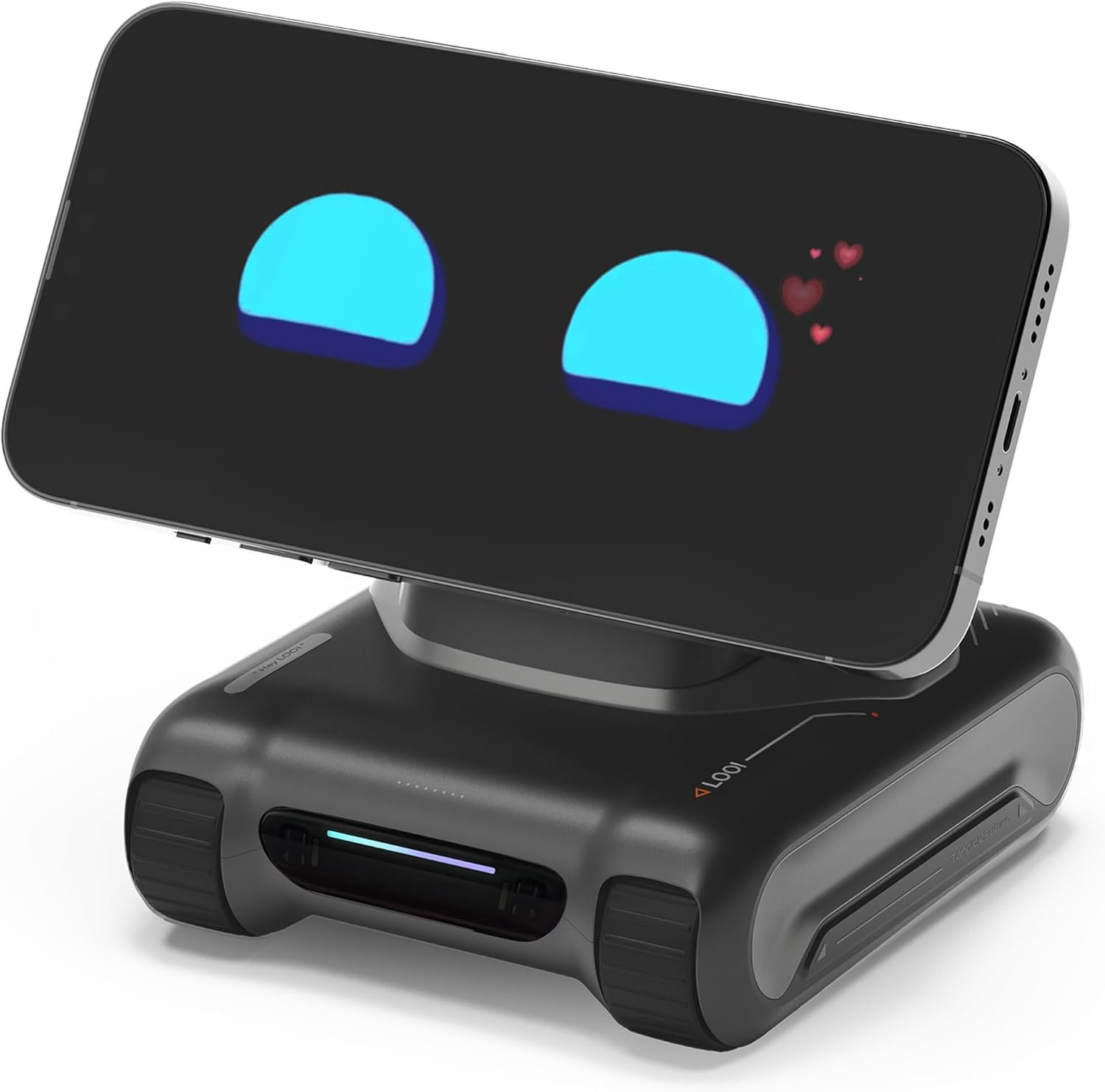
The LOOI Robot in Space Black is an example of this category. Positioned as an AI desktop companion, it is designed around voice interaction, visual understanding, and a personality-oriented approach to communication. Its advertised features include interaction with AI services such as ChatGPT and Gemini, memory-related functions, and 10W wireless charging. These capabilities place it somewhere between a conventional smart assistant, a desktop gadget, and an interactive electronic companion.
Unlike a traditional smart speaker, a desktop companion robot is intended to offer a more tangible presence. Its physical form can make interactions feel different from speaking to a phone or typing a question into a browser. Depending on its supported software and operating requirements, a device in this category may be used to ask questions, explore ideas, interact with AI, or add an interactive element to a home office.
However, AI companion devices also introduce questions that are less important when purchasing an ordinary desk accessory. Buyers may want to understand how the device connects to AI services, whether its features require an internet connection, how memory works, what information it processes, and whether the wireless charging feature supports their particular phone.
This guide explores the LOOI AI desktop companion from an informational perspective. It explains the advertised feature categories, practical usage scenarios, potential advantages, limitations, and questions worth investigating before making a decision. Because software capabilities, subscriptions, compatibility, and product specifications can change, readers should confirm current details through the manufacturer’s documentation and the Amazon product listing.
Understanding the LOOI AI Desktop Companion
LOOI belongs to a category of technology that combines artificial intelligence with a physical desktop device. Instead of interacting exclusively through a screen, users engage with a dedicated object that is designed to respond through supported input and output methods.
The product is described as an AI desktop companion in Space Black, with advertised ChatGPT and Gemini voice interaction, visual understanding, personality and memory features, and 10W wireless charging.
These features serve different purposes. Voice interaction focuses on communication, visual understanding concerns interpreting supported visual input, personality and memory relate to the character and continuity of interactions, and wireless charging adds a separate practical function.
Understanding the distinction between these capabilities is important because they do not necessarily operate under the same conditions. Some may depend on an internet connection, a companion application, device permissions, compatible hardware, or the availability of a particular AI service.
An AI desktop robot should also not automatically be treated as a fully autonomous household robot. A device designed for conversation and desktop interaction may not offer the movement, manipulation, navigation, or physical task capabilities associated with larger robotic systems.
For most prospective users, the relevant question is whether its combination of AI interaction, desktop presence, and additional features fits their intended use.
Key Features of the LOOI Robot
1. Voice Interaction With AI Services
One of the product’s advertised features is voice interaction with ChatGPT and Gemini. These are AI services that can support a range of conversational and information-oriented tasks, depending on the model, service configuration, and access available to the user.
Voice interaction can make certain activities more convenient than typing. For example, someone working at a computer may want to ask a question while keeping their hands on the keyboard. A student may prefer to speak a question aloud when exploring a subject, while a person developing an idea may find conversational brainstorming easier than entering several separate prompts.
Potential uses include:
- Asking general knowledge questions.
- Exploring unfamiliar concepts.
- Brainstorming article topics or creative ideas.
- Practising explanations of academic subjects.
- Generating outlines for personal projects.
- Discussing everyday technology questions.
- Requesting summaries or alternative explanations of information.
The quality of these interactions depends on more than the physical device. It can be affected by microphone performance, background noise, network connectivity, the AI service being used, software updates, and the clarity of the user’s question.
It is also important to distinguish between access to an AI service and ownership of that service. Advertising compatibility with ChatGPT or Gemini does not necessarily mean that every model, feature, or subscription benefit is included with the hardware. The current product documentation should explain whether users need separate accounts, subscriptions, application setup, or other services.
AI-generated answers may also contain mistakes or outdated information. Users should verify important claims, especially when dealing with medical, legal, financial, or other high-impact decisions.
2. Visual Understanding
The LOOI product description advertises visual understanding, suggesting that visual information can play a role in its supported AI interactions.
Visual AI systems can sometimes interpret images or scenes and use that information to provide contextual responses. In a desktop setting, this type of functionality may make interactions more flexible than a voice assistant that can only respond to spoken questions.
Depending on the device’s actual implementation, possible applications for visual understanding in AI products include discussing a visible object, interpreting supported visual input, or asking questions about information presented to the system.
For example, a user learning about electronics might want help identifying a component in an image. Someone working on a creative project might want to discuss the general appearance of a visual reference. A student could potentially use supported visual features to explore an educational diagram.
These are examples of uses associated with visual AI, not a guarantee that every scenario is supported by LOOI.
Before relying on the feature, buyers should establish how visual input is captured, whether the device contains a camera or uses another supported input method, what permissions are needed, and which image formats or functions are available.
Visual understanding also has limitations. AI systems may misidentify objects, overlook details, or misinterpret what an image shows. They should not be relied upon as the sole source of evidence for safety-critical inspection or other high-stakes assessments.
Privacy is another important consideration. If a device processes images, users should understand whether information is processed locally or transmitted to an external service, how data is retained, and whether any visual features can be disabled.
3. Personality-Oriented Interactions
The product listing highlights personality as part of its companion experience. In AI products, personality generally refers to the conversational style, tone, or character presented during interactions.
A system with a consistent conversational style may feel different from a conventional assistant that simply answers direct commands. It might respond in a more playful, friendly, or expressive manner, depending on its software and available settings.
For people who enjoy technology as a hobby, this approach can make a desktop device more engaging than a passive accessory. A user may appreciate having an interactive object on a desk that can participate in casual conversation or provide a more character-oriented interface to AI tools.
Personality can also affect the experience of using the same AI capability for different purposes. A casual discussion may benefit from a relaxed tone, while a technical question may require a direct and precise explanation.
Nevertheless, a programmed personality should not be confused with human consciousness, genuine emotions, or independent personal intentions. A conversational system can generate expressive responses without having human experiences.
This distinction matters when evaluating AI companions. The device can be an enjoyable part of a technology setup while still being understood as a software-driven product.
4. Memory and Continuity
Memory is another advertised feature of the LOOI companion. In AI systems, the term can refer to several different mechanisms, and it is worth determining which one a particular device supports.
Some systems maintain context during a single conversation. Others may store selected preferences or information across separate sessions. Still others may provide configurable memory controls that allow users to review, modify, or delete stored information.
These functions are not interchangeable.
Conversation context can help an AI respond coherently to follow-up questions. Persistent memory, when available, may allow a system to take account of previously saved preferences or recurring interests. The practical value depends on how accurately the system retains relevant information and how much control the user has over that information.
For example, a user might want an assistant to remember that they are learning a particular subject or prefer concise explanations. If the product supports persistent preferences, this could reduce the need to repeat those details in every interaction.
However, the exact memory behavior of LOOI should be verified in its current documentation. The product description alone does not establish what is stored, how long it is retained, whether users can inspect it, or whether information is shared with external AI providers.
Before enabling memory, consider what information the device may process. Avoid sharing passwords, authentication codes, financial account details, private business information, or other sensitive material unless the relevant service has appropriate safeguards and the information is genuinely necessary.
A useful AI companion should provide clear information about its data practices and offer meaningful controls over stored information.
5. A Physical Presence on the Desktop
A major difference between an AI desktop companion and a conventional AI application is the physical device itself.
A smartphone application is portable, while a browser-based assistant can be accessed from many computers. A dedicated desktop robot, by contrast, is designed to occupy a specific place in a workspace.
That physical presence may appeal to people who enjoy desk gadgets, interactive technology, and distinctive workstation accessories. It can become part of a personal setup alongside a monitor, keyboard, headphones, speakers, and lighting.
The experience is different from simply opening an AI website because the interaction is associated with a dedicated object rather than an ordinary application window.
However, physical presence also means the product requires space, setup, power management, and potentially additional connectivity. Buyers should consider whether the device’s size and operating requirements suit their desk.
The manufacturer’s current specifications should be consulted for dimensions, power requirements, supported operating environments, and other installation details.
6. 10W Wireless Charging
The LOOI product description advertises 10W wireless charging, adding a practical function beyond AI interaction.
Wireless charging can reduce the need to connect a compatible phone to a cable for every charging session. When integrated into a desktop accessory, it may help organize a workspace by combining an electronic companion with a charging location.
However, wireless charging depends on compatibility between the charging surface and the device being charged. Support can vary according to the phone model, charging standard, alignment, case thickness, and other conditions.
The advertised 10W figure should not be interpreted as a guarantee that every compatible phone will receive 10W of power. Actual charging performance may be lower because of device limitations, thermal management, positioning, or other technical factors.
Buyers should verify which phones and charging standards are supported, whether a separate power adapter is required, and whether the advertised charging feature operates while the AI companion is active.
Wireless charging is a convenience feature rather than a replacement for checking the requirements of the phone and the charging accessory. It should also be considered separately from the robot’s AI capabilities: a device may offer useful charging functionality even when its conversational features are not in use.
7. A Gadget-Oriented Design
LOOI is presented as a technology-focused desktop companion and an electronic gift. That positioning may appeal to people who enjoy experimenting with AI, collecting unusual gadgets, or customizing their workspace.
The combination of a physical robot and conversational software can be more distinctive than a conventional computer accessory. It may also provide an approachable way to explore how AI is being incorporated into consumer electronics.
Still, appearance and novelty are only part of the decision. A gadget that looks interesting on a desk may be less useful if it is difficult to configure, depends on services the user does not want to maintain, or offers features that do not fit their habits.
A sensible evaluation should consider the product’s ongoing usefulness, compatibility, privacy controls, and setup requirements alongside its visual design.
How the LOOI AI Desktop Companion Can Be Used
The potential uses of an AI desktop companion depend on its supported features, but several everyday scenarios help explain where this category may fit.
Supporting Everyday Research
People often encounter questions while working on a computer. They may want a definition, a simple explanation, or a starting point for further research.
A voice-enabled AI companion may provide a convenient way to ask questions without switching repeatedly between applications. For example, someone researching a new technology could ask for a plain-language explanation before reading technical documentation.
The response should be treated as a starting point rather than a final authority. For factual work, users should consult reliable sources and verify important details.
Brainstorming Creative Projects
Content creators, bloggers, students, and hobbyists often need help generating ideas or organizing their thoughts.
A conversational AI interface can support brainstorming by suggesting possible topics, comparing approaches, or helping structure an initial outline. A person planning an article, for example, might use AI to identify questions a reader could have about a subject.
The final work still requires human judgment, editing, and fact-checking. AI suggestions can be repetitive, incomplete, or incorrect, and original content should reflect the creator’s own research and editorial decisions.
For users who prefer speaking rather than typing every idea, voice interaction may offer a convenient alternative.
Exploring Educational Topics
Students and lifelong learners can use conversational AI to explore subjects they find difficult.
A learner studying programming might ask for a conceptual explanation of a loop or variable. Someone learning a new language could practise simple conversational exchanges if the relevant service supports that use. A student studying economics might request an example that illustrates an unfamiliar concept.
The educational value depends on how the tool is used. Asking follow-up questions, checking explanations against course materials, and attempting exercises independently can support deeper understanding than simply accepting generated answers.
AI systems can also make errors in calculations, definitions, and explanations. They should complement established learning resources rather than replace teachers, textbooks, or formal instruction.
Organizing a Home Office
A desktop companion can occupy a place in a home office alongside a laptop, external monitor, and other equipment.
If its supported AI features are useful during work, it may become a convenient point of access for quick questions and brainstorming. Its wireless charging function may also provide a designated place for a compatible phone.
However, users should consider whether a conversational device will be helpful or distracting. People who frequently participate in video calls may need to think about microphone placement, background audio, and whether the companion’s interactions could interfere with meetings.
The device’s physical footprint and power requirements should also be considered when planning a compact workspace.
Adding an Interactive Element to a Desk Setup
Some people choose desktop accessories primarily because they enjoy the technology itself.
An AI companion may suit a desk built around gadgets, robotics, gaming equipment, or smart devices. Its interactive features can add a different dimension to the setup compared with a static ornament.
For hobbyists, the product may also provide a way to explore the broader consumer AI ecosystem, including conversational interfaces and the relationship between software and physical devices.
The level of interaction, customization, and responsiveness should be verified before purchase rather than assumed from promotional imagery alone.
Using AI for Personal Planning
Conversational AI can sometimes help users break down a broad goal into smaller tasks or think through a personal project.
For instance, someone planning a study schedule might ask for a sample weekly structure. A person preparing a presentation could request an outline or a list of questions to investigate.
Whether LOOI can perform these tasks in a convenient way depends on the AI services and software features available in its current configuration.
Users should also remember that generated schedules and suggestions are not automatically synchronized with calendars or task-management applications. Any integration should be confirmed in the product documentation.
Who May Find the LOOI Robot Suitable?
Technology Enthusiasts
People who enjoy experimenting with new devices may appreciate a product that combines AI interaction with a physical desktop form.
It offers a way to explore a consumer technology category that differs from traditional smart speakers and phone applications. The appeal may be especially strong for users who like trying new interfaces and observing how AI features evolve.
Remote Workers and Home Office Users
A desktop companion may interest people who spend substantial time at a computer and want quick access to conversational AI.
It could be useful for occasional questions, brainstorming, or learning activities, provided its interaction method fits the user’s workflow. Workers who require uninterrupted concentration, however, may prefer a less interactive accessory.
Students and Independent Learners
Learners who frequently ask questions and explore new topics may find voice-based AI convenient.
The device could become an additional learning aid, but students should confirm its account requirements and service access. They should also use it responsibly and follow academic rules regarding AI assistance.
Gadget Collectors and Desk Setup Enthusiasts
People who enjoy distinctive computer accessories may be interested in LOOI because it combines a physical device with AI features.
Its potential value for this audience may include the interactive experience, visual presence, and additional charging functionality. Buyers should still consider whether they want an actively used device or mainly a decorative object.
Gift Buyers
The product’s technology-oriented positioning may make it relevant for someone who enjoys robotics, artificial intelligence, or unusual desktop gadgets.
Before giving it as a gift, consider the recipient’s interest in connected devices and willingness to complete software setup. A product that requires account registration, network access, or a compatible phone may be less suitable for someone who prefers simple, offline accessories.
Confirming these requirements can help avoid giving a device that the recipient cannot easily use.
Important Things to Consider Before Choosing LOOI
Internet and Account Requirements
Connected AI devices may depend on internet access for conversational responses or other cloud-based features.
The product listing should be checked for Wi-Fi requirements, supported phone operating systems, companion applications, account registration, and any necessary setup process.
If the device relies on an external AI service, availability may also depend on that service’s terms, regional support, and ongoing operation. A feature advertised today may change as the underlying software evolves.
AI Service Access and Possible Additional Costs
The reference to ChatGPT and Gemini does not automatically establish that all associated services are included without additional fees.
Some AI capabilities may require separate accounts, subscriptions, usage limits, or specific access levels. Others may be available through a particular integration provided by the device manufacturer.
Before purchasing, verify which services are supported, which models or features are available, and whether ongoing payments are required. Do not assume that buying the hardware includes a paid subscription to an external AI platform.
Privacy and Data Handling
AI companion devices can raise privacy questions because users may speak to them in shared spaces and may enable memory or visual features.
Before using the device, review its privacy policy and the policies of any external AI service it connects to. Determine whether audio, images, transcripts, or conversation history may be transmitted to remote servers, and learn how stored data can be deleted.
If the device uses a camera or microphone, understand when those components are active and whether recording indicators or privacy controls are available. Avoid placing a connected device in locations where private conversations or sensitive information could be captured unintentionally.
For workplace use, consider company policies before discussing confidential documents or business information with an AI assistant.
Accuracy and Reliability
AI-generated responses can sound confident even when they are wrong. They may misunderstand spoken questions, overlook visual details, or provide information that is no longer current.
This is especially relevant when using AI for technical troubleshooting, professional research, or important decisions.
Treat the companion as a tool for assistance and exploration rather than an unquestionable source. Check significant claims against authoritative sources and use professional advice where appropriate.
Compatibility and Setup
The actual experience depends on the device’s supported hardware and software.
Check which smartphones, operating systems, charging standards, and network configurations are supported. If the product requires a particular application or a specific version of an operating system, confirm that your existing equipment meets those requirements.
Also examine the setup instructions. A technically curious user may enjoy configuring a connected gadget, while someone expecting a completely plug-and-play experience may want to understand the process first.
Charging Performance
The advertised 10W wireless charging feature may be useful, but its practical value depends on the phone and charging setup.
Confirm whether your phone supports the relevant wireless charging standard, whether its case affects alignment, and whether the necessary power adapter is included. Review any manufacturer guidance about simultaneous operation and charging.
If fast charging is a priority, compare the device’s verified charging specifications with the requirements of your phone rather than relying solely on the wattage mentioned in the product title.
Long-Term Software Support
Connected gadgets can depend on software updates, external services, and ongoing compatibility.
Consider whether the manufacturer provides documentation about updates, troubleshooting, customer support, and service availability. If an AI integration changes, the device’s functionality may also change.
This matters particularly for products whose appeal depends heavily on cloud-based AI rather than simple offline functions.
Physical Space and Everyday Distractions
A desktop companion needs a suitable place on a desk. If the workspace is already crowded, its dimensions and positioning may matter.
Voice interaction can also introduce interruptions. Someone who spends the day writing, coding, or attending meetings may prefer to establish clear times for using the device rather than leaving it active throughout every task.
A device is more likely to be useful when it supports an existing routine instead of competing with it.
Comparing AI Desktop Companions With Other Device Categories
Understanding the alternatives can help clarify what makes a product like LOOI different.
AI Desktop Companions Versus Smart Speakers
Smart speakers generally focus on voice commands, audio playback, information requests, and supported smart home functions. Their design often prioritizes sound output and hands-free interaction.
An AI desktop companion emphasizes a physical character or robot-like presence alongside conversational interaction. Depending on the model, it may offer visual features or a more expressive interface.
Neither category is automatically more useful for every user. Someone who primarily wants music playback or voice-controlled lights may prefer a conventional smart speaker. Someone interested in an interactive desk gadget may be more drawn to a companion robot.
AI Desktop Companions Versus Smartphone AI Applications
Smartphone applications offer portability and access to AI services from almost anywhere. They can be convenient for people who already use a phone as their main personal device.
A dedicated desktop companion instead provides a separate physical interface in a fixed location. Its appeal may come from the interaction style and integration into a workstation.
The trade-off is that a dedicated device can require additional setup, space, and maintenance. Users who only need occasional AI assistance may find a phone application sufficient.
AI Desktop Companions Versus Traditional Desktop Gadgets
Traditional desk accessories include lamps, charging stands, figurines, clocks, and organizers. Their functionality is often predictable and does not depend on conversational software.
An AI companion adds software-driven interaction, which can make the experience more flexible but also more dependent on connectivity and updates.
People who prefer simple accessories that work without accounts or internet access may prefer traditional gadgets. Those interested in exploring conversational AI may see value in a connected device.
AI Desktop Companions Versus Educational Robots
Educational robots are often designed around structured learning activities, programming exercises, or specific developmental goals.
A general-purpose AI desktop companion may instead focus on conversation, personality, and everyday interaction. It should not automatically be considered an educational robotics platform simply because it incorporates AI.
Parents and educators should check the manufacturer’s age guidance, privacy provisions, content controls, and supported educational features before using any connected AI product with children.
Frequently Asked Questions
What is the LOOI AI desktop companion?
LOOI is marketed as an AI desktop companion robot. Its product description highlights voice interaction with ChatGPT and Gemini, visual understanding, personality and memory features, and 10W wireless charging.
The precise capabilities and operating requirements should be confirmed through the current product listing and manufacturer documentation.
Does LOOI support ChatGPT and Gemini?
The product description advertises interaction with both ChatGPT and Gemini. However, the exact integration, supported models, access requirements, and availability of individual features should be verified before purchase.
Compatibility does not necessarily mean that all functions of either AI service are included.
Does the robot require an internet connection?
Connected AI devices commonly require internet access for cloud-based features, but the exact requirements for LOOI should be checked in its current setup documentation.
Confirm whether an internet connection is necessary for initial setup, voice interaction, software updates, or other advertised functions.
What does visual understanding mean?
Visual understanding generally refers to an AI system’s ability to interpret supported visual input and use it when responding to a user.
The specific visual capabilities available on LOOI depend on its hardware and software. Check how visual input is provided, what tasks are supported, and what permissions are required.
What does the memory feature do?
Memory can refer to conversational context or the ability to retain selected information across separate sessions.
The product description advertises memory-related functionality, but buyers should confirm what information LOOI can remember, whether that information persists, and what controls are available for viewing or deleting stored data.
Can LOOI charge a smartphone wirelessly?
The product description advertises 10W wireless charging. Actual compatibility and charging performance depend on the phone, supported charging standard, alignment, and other technical factors.
Check the manufacturer’s compatibility information and confirm whether a separate power adapter is needed.
Is the 10W charging speed guaranteed for every phone?
No. A stated charging wattage does not guarantee that every phone will charge at that rate. The phone must support compatible wireless charging, and actual output may be affected by the charging setup and device limitations.
Consult both the phone manufacturer’s specifications and the LOOI documentation.
Is LOOI suitable for a student?
It may interest students who want to explore conversational AI, ask general questions, or brainstorm ideas. Its suitability depends on the student’s needs, the device’s setup requirements, and the availability of appropriate privacy and content controls.
AI-generated educational material should be checked against reliable learning resources.
Is this type of device useful for a home office?
It may be useful for people who enjoy having a dedicated AI interface on their desk. Potential applications include brainstorming, general questions, and selected planning tasks.
Its usefulness depends on whether the interaction method fits the person’s workflow and whether the device introduces unwanted distractions.
Does the device have to remain connected to external AI services?
That depends on its architecture and the functions being used. Cloud-based conversational features generally require access to the relevant service, while other functions may operate differently.
The current product documentation should clarify which capabilities require internet access and whether any features work offline.
Is an AI desktop companion the same as a human companion?
No. Although conversational software can produce friendly or expressive responses, it does not establish that the device has human consciousness, emotions, or personal experiences.
It is more accurate to understand the product as a connected electronic device that provides an interactive AI experience.
What should buyers check before purchasing LOOI?
Review the included hardware, supported devices, internet and account requirements, AI service access, privacy controls, wireless charging compatibility, setup process, and software support.
These details help establish whether the product is appropriate for your workspace and whether its advertised features match your expectations.
Conclusion
The LOOI Robot in Space Black combines several technology categories in a single desktop-oriented device. Its advertised features include voice interaction with ChatGPT and Gemini, visual understanding, personality and memory functions, and 10W wireless charging.
This combination may appeal to technology enthusiasts, home office users, students, and people who enjoy interactive desk accessories. Voice-based AI can offer a convenient way to explore questions and ideas, while personality-oriented interaction gives the device a different character from a conventional computer accessory. Wireless charging adds a separate practical function when used with compatible phones.
However, the value of an AI companion depends on more than its feature list. Buyers should verify the exact AI integrations, connectivity requirements, account or subscription conditions, privacy controls, charging compatibility, and long-term software support. They should also understand that AI responses can contain errors and that advertised visual or memory capabilities may have specific limitations.
For users who want a connected gadget that combines conversational AI with a physical desktop presence, LOOI may be worth investigating. Those who mainly need portable AI assistance, a basic wireless charger, or a simple desk accessory may find that a more specialized alternative better matches their needs.
The most sensible approach is to compare the product’s verified specifications with the features you will actually use.
You can check more details on Amazon here:
As an Amazon Associate, we earn from qualifying purchases.